Showing posts with label Doggy wisdom. Show all posts

Monday, 22 September 2014

The Secret to Keeping Your Dog Happy

Your dog brings you joy. Do you ever look over at her while she is sleeping and wonder if you make her as happy as she makes you? Is she as glad to be yours as you are to be hers? How do you know if your dog is content? All social species have the same basic needs, just different ways those needs are fulfilled.

Physiological Needs
Clean water - The most basic and most vital need for dogs is fresh clean water. Give your dog virtually unlimited access to water. The only exception is limiting a few hours before bedtime when housetraining. Keep water bowls clean and free of debris. Make sure outside water does not freeze in winter or overheat in summer. Change water in outdoor containers often. Stagnant water can lead to disease. It doesn't have to be Evian, but it should be fresh! If your dog has a habit of knocking over her water bowl, it's not because she doesn't want water. It's because dogs live in the right now, and right now it's fun. It doesn't occur to her that later, she won't have any water to drink. Weighted water bowls will solve this problem.

Good Nutrition - Ask a dozen people what dog food is the best, you will get a dozen answers. The elusive Absolute Best Brand has not yet revealed itself. However, there are better and worse choices. Feeding a quality dog food means your dog will be healthier from the inside out - from a stronger heart and bones to a shinier coat with less shedding and itching. The little extra money spent on a better food is more than made up for in fewer Vet visits. Nutritionally balanced dogs get sick much less often, fewer ear infections, fewer outbreaks of worms, fewer UTIs, and even fewer injuries. There is even evidence that better food makes for a better behaved dog, as well! A quality dog food will have meat as at least the first 2 ingredients and little or no corn as a filler. Dogs are primarily meat eaters. If your dog has a dull coat and flaky skin, it could be her food! 
In addition to the right type of food, your dog also needs the right amount of food. This is a case where you can get too much of a good thing. Being overweight causes health problems in dogs just as in people. Since dogs have a shorter life span than humans, the ill affects are even more severe for them. Overweight dogs are not happy dogs. Lucky for them, it's much easier for them to follow a diet than it is for us. We control their access to food. They can only eat as much as we give them. Feed them a measured amount on a schedule, usually twice a day, rather than free feeding. The dog food bag tells you how much to give. Even that is too much for some dogs. Observe your dog's weight and adjust the amount you feed her accordingly. A dog is at her ideal weight when you can easily feel the ribs and can see the outline of the ribs when the dog turns sideways. She is underweight if you can see the ribs easily, and overweight if the ribs and hip bones are not easily felt and she has no waist. 

Exercise - In addition to proper nutrition, exercise is vital for good health. Not only will it increase your dog's longevity, it will also decrease her unwanted behaviors. A dog's energy has to go somewhere. If she doesn't get enough exercise, she may find undesirable ways to expend that extra energy or even develop neuroses such as obsessive spinning. Just as you should see your doctor before starting an exercise program, so should your dog see hers! Some breeds need more exercise than others, and some cannot tolerate intense activity. Be sure your dog's exercise program is right for her breed.

Good Hygiene - It's true, dogs love to roll around in the stinkiest thing they can find. They don't seem to mind being dirty or smelly. However, for a dog's overall happiness, cleanliness is next to dogliness! Dogs may not care how they smell, but people sure do. A smelly dog does not get petted by people and generally isn't allowed in the house, and a dog shunned to the back yard with little or no human contact is not a happy dog. Filthiness can also lead to health problems. For example, dirty ears can lead to ear mites which are itchy and can cause ear infections. Being too dirty can also be painful, especially for a long-haired dog. Mats in a dog's fur pull on the skin and are extremely uncomfortable. Nails that grow too long can cause a dog to walk awkwardly and lead to problems in their joints and muscles. Keeping coats brushed, ears cleaned, and nails trimmed is essential for a happy dog. Bathing too often can lead to dry itchy skin. Dogs need a bath only when they start to smell bad. If your dog is on a quality food, this won't be very often. 

Chew Toys - Dogs have a physiological need to chew. This is especially true for teething puppies. Providing them with safe chew toys will help them satisfy this urge without having to gnaw on your coffee table. Thick rubber toys like Kongs are a good option because they will not break apart and become a choking or obstruction hazard. 

Elimination - Dogs need reliable and sufficient opportunity to eliminate away from their sleeping area. Normal healthy dogs will not eliminate where they eat and sleep. Dogs who do use the bathroom in their dens do so because they have learned that they will not be given sufficient opportunity to eliminate elsewhere. For optimal happiness, make sure your dog doesn't have to hold it too long. 
Shelter
In the wild, dogs are able to seek out shelter when they need it to get out of the rain, to shield themselves from the cold, or to find relief from the heat. In a domestic environment, we keep them confined to a limited area. They don't have the option to go out and look for adequate shelter. Therefore, it is up to us to provide it. The ideal place for your dog when it's raining or cold is in the home with you. Most dogs are happiest living inside with you. It's also the easiest way to provide appropriate shelter. However, if your dog is one of the few who prefer living outdoors, or bringing her inside is not an option, you can make sure she is well-sheltered outdoors. 
Some breeds are simply not equipped to deal with cold weather and should not be left outside in winter. This includes most of the small breeds and the short-coated large breeds, such as Dobermans. Remember, these are man-made dogs. Cropped coats and tiny dogs do not occur in nature. Likewise, some breeds are not equipped to deal with the heat of SC summers and should not be left outside in hot weather. This includes the arctic breeds such as Siberian Huskies, Alaskan Malamutes, and St. Bernards. These dogs living outdoors are not only unhappy dogs, they are also not safe! They could literally die from the heat.  
Security
Happy dogs feel safe in their environment from threats either real or perceived. Dogs who live confined outdoors but without a physical fence are not secure. Invisible fences and chains may keep the dog in the yard, but they do not keep other animals out. A dog living this way is a sitting duck. She is vulnerable to attacks from coyotes, other dogs, and even mean people, and she has no way to escape. The dog who lives this way is not a happy dog.

A happy dog trusts her owner to not put her in harm's way. She knows exactly what is expected of her and what happens when she doesn't follow the rules. She does not fear her owner because she knows he will do her no harm. She is also not overly dependent on her owner because she feels secure in being alone sometimes. A trained dog is a secure dog.
Social Needs
Dogs are social animals who thrive on companionship with others. They are unique in the animal world because they enjoy companionship with people as much as they do with other dogs. A dog who lives in a backyard with only minimal human contact is a lonely dog, like a hermit living on an isolated mountain. The happy dog gets lots of ear scritches and belly rubs. She gets to associate with lots of different people and dogs because she has been well-socialized and trained in basic obedience and manners. She is a dog who can go anywhere, and people are happy to see her.  

Esteem Needs
Do dogs have a sense of self-esteem? If you doubt it, just watch a dog who has accomplished a complicated task. See how she holds her head high and struts! Dogs need to have confidence in themselves and their ability to master tasks. Training a dog builds her self-esteem. It makes them feel good to master the perfect Sit and earn your appreciation! Learning tricks is fun for dogs. There are also all sorts of canine sports available that dogs enjoy. Agility, flyball, ultimate frisbee, and lure coursing are just some of the examples. A dog with a hobby is a fulfilled dog.

Cognitive Needs
Dogs are more than just instincts. They also have the ability to think and problem solve. They need to experience more than just the same old scenery of their own home. Mental stimulation leads to a happy dog. Just walking a different path and letting her smell new smells and see new sights provides mental stimulation. At home, puzzle toys like the Buster Cube let her put her brain to use. You can play games with her like hiding and she has to find you, or hiding a treat that she has to find. Learning new tricks also works her brain. Put her to work. Make her fetch the paper (make sure it's safe first) or bring you a drink from the fridge. Yes, working makes for a happy dog!


The Secret to Happiness
The meaning of life is to live it. The secret to a happy dog is to help her live a fulfilled life. That means she actively participates in it. She plays, goes places, and does things. Basically, the secret to a happy dog is not much different at all from the secret to a happy person. 


Keep those happy tails wagging
Bear's P4ws


Wednesday, 11 June 2014

Petting Dogs: Why Consent is Important

Originally written by a trainer at PawsAbilities this blog/article cover such an important topic for all dog owners to understand and advocate that I simply had to re-post it.

“Come give Sara a hug goodbye,” my friend tells her 3-year-old son. His eyes get big, and he stands behind his mother, hugging her legs. It’s an uncomfortable moment. My friend is embarrassed that her son clearly doesn’t want to hug me. She wants to teach him manners, and worries how his reaction reflects on her parenting. It’s been so long since we last saw each other that her son barely remembers me, and he’s very uncomfortable with the idea of such an intimate goodbye. I’m also not a fan of the idea, since I don’t want to touch anyone, no matter the age, without his or her express consent, even for something as minor as a brief embrace.
“Do you want to wave goodbye instead?” I ask my friend’s son. He nods and smiles shyly, waving bye-bye. The tension in the room relaxes, and I hug my friend goodbye while her son stands in the background, relief palpable in his demeanor as he waves. I hope that I’ve given both him and his mother the tools to deal with similar situations gracefully in the future. It’s okay if he doesn’t want someone to touch him, and he can always offer an alternate suggestion that he feels more comfortable with.
It’s not okay to touch others without their consent. As grabby primates, this can be a hard rule for us to follow. It’s not okay to rub a stranger’s pregnant belly, or to ruffle a child’s curly hair without her permission. If someone doesn’t want to shake hands or hug, waving or giving a fist bump may be more appropriate. We learn as young children to keep our hands to ourselves, and it’s something that we need to remember our entire lives. It’s also something we need to remember when we interact with dogs.

Not every dog likes to be touched. Sure, most dogs enjoy petting and scratching, especially in those hard-to-reach areas such as under their collar and along their spine. However, just like us, every dog has a different level of tolerance for physical affection. Some dogs, just like some people, can’t get enough of touch. They’re happiest when they can lean against you, skin-on-skin, and feel your hand caressing them. Other dogs, just like other people, prefer not to be touched except by a handful of those they know and trust, and even then, only at certain times and in certain places.
You wouldn’t run up and hug a stranger who was walking in the park just because you liked the color of his or her eyes, and it’s just as inappropriate to hug or pick up a dog you don’t know just because you think it’s cute. If a stranger approaches your dog and wants to pet him or her, and your dog doesn’t seem comfortable with the idea, it’s absolutely alright to tell that person no. Just as you would stand up for a child or a vulnerable adult who was unable to tell the stranger no, it’s okay to stand up for your dog. Dogs are not public property, and no one has the right to pet your dog unless you and your dog are both okay with them doing so. 

Of course, this isn’t to say that you shouldn’t teach your dog to accept petting and to greet people appropriately. Dogs have to live in a world where people will reach out for them without asking first, so give your dog the tools to cope with this gracefully by socializing him appropriately.
If you want to pet a dog, whether it’s your own pet or a dog you just met, make sure that you ask first. Asking the owner is important, but even more importantly, I want you to ask the dog. Ask the dog if he or she wants to be touched, and then respect the answer you’re given. 

How do you ask a dog whether she wants to be petted? Dogs aren’t verbal, so they can’t verbally express what they want. However, they do have a complex and nuanced language of their own, and we can watch their body language to determine whether they want to be touched or not.
Start by crouching down a few feet away from the dog you’d like to pet, talking to him or her softly. If the dog approaches, that’s a good sign that she’s interested in interacting with you. If she maintains her distance, that’s an equally good sign that she’s not currently comfortable interacting and that you should give her some space.

Once the dog approaches you, gently pet her under her chin, on her chest, or along her side for 1-2 seconds. Pause and see what she does. If she moves closer to you, leans in, nudges at your hand, or otherwise interacts further with you in a social way, she is telling you that she enjoyed being touched and would like to be petted more. Go ahead and oblige. If she stiffens up, moves away, or does not show any social body language, stop touching her. You do not have her consent to continue putting
your hands on her body. This should go without saying, but if the dog shows warning signs such as whale eye, growling, snarling, snapping, or biting at you, stop what you’re doing immediately and give her some space.
Every so often as you’re petting the dog, stop and ask whether she’d like you to continue by watching her body language. Whenever you pet her in a new place on her body or in a new way (for example, ruffling up the fur above her tail instead of softly stroking her shoulder), stop after a few seconds and evaluate whether she enjoyed that. Many dogs have definite preferences about where they enjoy being touched the most, so ask for the dog’s feedback and watch her respond ecstatically as you scritch just the right spot.

If someone else is petting your dog, ask them to follow these same instructions. Watch your dog’s body language, and be ready to redirect the person if your dog becomes uncomfortable.
It’s a sad reflection of our society that I’m often accused of not liking my clients’ dogs upon first meeting them because I don’t immediately try to pet them. People seem hurt and confused that I don’t instantly reach out for their dogs, especially since I clearly love dogs so much. When I explain that I don’t pet dogs without the dog’s consent, it’s often very eye-opening for my clients, who were taught that anyone should be allowed to touch a dog whether the dog wants it or not. These same clients are often amazed that their dogs don’t show the same aggressive behavior towards me that they do towards most visitors to the home, or that their fearful dog warms up to me so quickly. This isn’t magic. It’s just respect. I respect each dog’s right to choose how closely he or she wants to interact with me, and dogs respond to this respect enthusiastically.


Bark back at us!  How do you handle strangers (children especially) who love dogs and lunge for them when they cross you in the street or at the park?

Keep your tails wagging
Bear

Friday, 5 July 2013

The Healing Power of Dogs

Scientific research proves what many people have known for centuries: it’s good to have a dog in the house. Dogs keep us company, help us stay active, and can even warn us of intruders. But did you know that dogs may improve the physical and mental health of their human companions?
Awesome isn't it?

for the original click HERE

Keep your tails wagging, 
Bear's P4ws

Wednesday, 3 July 2013

Canines, cars and common sense

An open letter, from a Dog to his Owner
by Andrew Clark
originally for  The Globe and Mail

 Dear Owner,
 
I’d call you Master. but I’m still a little angry.

I’m writing to follow up on the incident last week. You may recall that you left me, Parker (100-pound black-and-brown brindle mastiff), in a locked SUV on a day when the temperature peaked out at 33.8 degrees. A passerby, who saw what appeared to be a dog in a four-wheeled microwave, called the authorities. He was concerned. After all, only two weeks ago a dog died after being left in a broiling car.

Anyway, the police arrived and rescued me from the steamy SUV. Guess what they did next? Tried to put me in another car, and I was like, “No thanks, been there, done that” and I did what any other animal in my situation would do – I ran.
Unfortunately, I ran onto the expressway and, as anyone who commutes knows, that’s the last place you want to go if you want to go anywhere fast. I held up traffic for a while until the police came for me again. It made all the news reports and the video went viral. And why not? There’s a DOG on the EXPRESSWAY! Stop the presses! Don’t get me started on the media.

I’m writing to clear up a few misconceptions about canines and cars. Not just to you, my owner, but to all drivers who love their dogs. Look, the feeling is mutual. We love you. But any relationship needs boundaries. As far as these go, dogs are among the most laid-back creatures on earth. We have few. Wanna make us retrieve a stick for three hours? We’re in! Want someone to silently listen to you complain about your life for an entire morning? Done.

It is only when you literally try to cook us alive that things get tense. My case is not the only example. In Toronto, between June 16 and 21, there were 61 reports of dogs left in vehicles. You could say, “Okay, Toronto, those people are morons,” but the same thing has happened in California, New Jersey, Oregon and many other places.
Meanwhile, here are some other recent dog-related headlines:

“Dog Saves Girls from Venomous Snakes,” “Dog Gives Life to Save Owner From Dangerous Trailer Fire” and my personal favourite, “Dog Rescues Newborn Baby After He Was Left in the Woods to Die.”
I’m not kidding – this totally hard-core farm dog in Ghana found this kid, and pulled the abandoned newborn under a bridge where he kept him warm all night.
You’ll notice nowhere can be found the headline, “Dog Leaves Human in Sweltering Locked Car So He Can Take Advantage of Sale at Abercrombie & Fitch.”

I’ve heard somewhere that humans like lists, so I will try to streamline these into a PowerPoint presentation (my lack of opposable thumbs means I can’t actually conduct a PowerPoint presentation, so just try imagine the cool graphics).

Activities dogs can help with
Fetching
Pooping on lawns of neighbours you don’t like (no need to tell us, we can sense it)
Not passing judgment
Eating food you don’t want but feel too guilty to throw out
There are plenty more but you’ll notice, we’re on board for a lot.

Activities dogs can’t help with
Shopping
Driving
Witty passenger seat conversation
Sauna buddy

I think we’re looking at a misunderstanding that stems from semantics, the kind of disconnect explored by German-born philosopher Rudolph Carnap, whose verification principle maintained that anything that can contribute to human life can be observed. “There is a continuum which starts with direct sensory observations and proceeds to enormously complex, indirect methods of observation.”

For instance, using observation you can deduce that dogs like driving. Let’s face it, we LOVE DRIVING. One jingle of the keys and it’s on. We love driving in cars.
We do not, however, like sitting in parked cars, especially if the interior of the car resembles the inside of an electric Wolfgang Puck Pressure Cooker making pulled pork.
We’re also not that big on shopping. Why do you feel it’s necessary to take us with you? If you want help selecting raw meat, we’re in, but otherwise we’re okay taking a pass. I know that we make big fuss when you’re going out. Practically begging to come with you. It breaks your heart to leave us.

Look, I’m going to come clean and say we totally ripped off that one from preschoolers. You know how they flip out and cry when their moms drop them off at daycare? Then, like three seconds after the mom is gone, they’re totally over it and playing. We stole that one. So, when you’re leaving we’re all “Please! Take me with you! PLEASE.” But three seconds after you’re gone we’re asleep.

How can you tell if it’s too hot to leave your dog in you car? Simple. Before you leave us, turn off the air conditioning and sit in your car. If it’s so hot you think you are going to vomit and pass out? Too hot. Keep it simple: in the summer months don’t leave us locked in the car.

This has got to stop.

We dogs have a saying. “Humans. Can live with them. Could easily live in the wild without them.”

Face it, you need us more than we need you. So let’s make a deal. We’ll keep saving you from fires, rescuing your abandoned infants and being unbelievably happy to see you when you get home.
You stop leaving us in parked cars.

Deal?

Yours truly,
Parker

P.S. The irony of my name is not lost on me.


...When you really stop and think about it, it's not a lot to ask....is it?

Keep your tails (safely) wagging,
Bear's P4ws


Patience...

...is not the ability to wait...


...but the  ability to keep a good attitude while waiting
=)

Keep you tails wagging, 
Bear's P4ws


Wednesday, 5 June 2013

Dog Park Bliss...

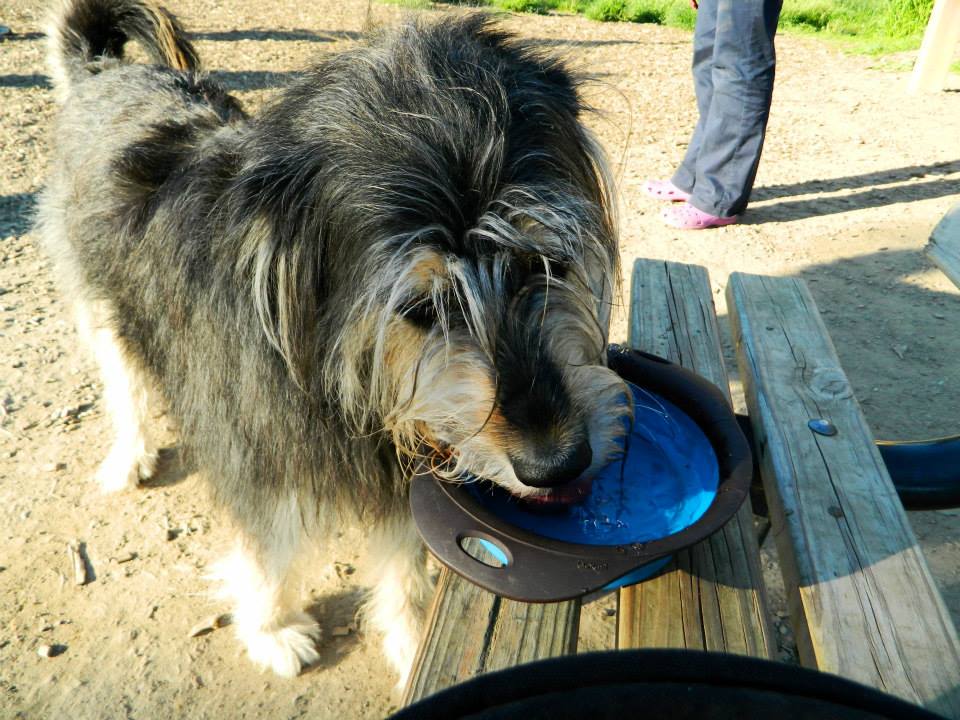
Staying hydrated is super important....


...Bear keeps his water bowl on a bench to avoid getting dust in it from all the romping puppies
=)

Keep your tails wagging
Bear's P4ws

Friday, 3 May 2013

Having Fun with Your Dog

“A tired dog is a good dog.” While you’ve probably heard the saying many times, there’s a lot of truth to that simple phrase. Bored dogs will often try to entertain themselves—whether that means chewing your shoes, barking at what seem like imaginary sounds, digging up your flower garden, or chasing their own tails.
Playtime can solve many behavior problems and help you strengthen the bond with your dog at the same time. Walks—preferably twice a day for at least half an hour each—are a great way to help your dog (and you) burn some calories but playing together adds a whole additional layer of activity. Just as children learn and develop through play, our pets need the stimulation, both mental and physical, that play can provide to develop their full potential.
Spring is an excellent time to get out and have fun with your four-legged friend. After a winter of often abbreviated outdoor activity, the warmer weather calls for outdoor action. Here’s a look at inexpensive and fun ways to get out and celebrate the warm weather with your dog:

Play fetch.
Not every dog loves the game of fetch from the start; some require some time to learn why it’s fun to repeatedly chase an object you toss. Be aware of the type of object your dog enjoys fetching, a tennis ball, a toy, or a flying disc. Reward your dog when he returns the toy with lots of praise or treats, and he’ll learn to love this game. Eventually, you can graduate to longer throws (try a tennis racquet if you need help) or uphill fetch games to help your dog get more exercise.

Play hide and seek.
Dogs enjoy a good game of hide and seek, and it’s a great way to help exercise your dog’s problem solving abilities at the same time. Start with your dog in a sit- (or down-) stay then hide in a fairly easy-to-find place. Be sure to have some great rewards with you, like super treats or a favorite toy, so you can praise your dog when he finds you. As your dog gets better at this game, you can graduate to more difficult-to-find locations that require your dog to rely on scent to locate you.

Create your own dog park with friends.
Do you and a couple of neighbors have fenced yards and dogs that enjoy each other’s company? Arrange a play date every week for your dogs to enjoy some fun play time. It will save you a drive to the dog park, save some gas money, and help socialize Fido and you at the same time.

Freestyle fun.
OK, you’re no Fred Astaire or Ginger Rogers but you can get out and enjoy some freestyle dance fun with Fido. Turn up some tunes and dance with your dog. With a search for “canine freestyle” on YouTube, you’ll find many videos of competitive freestyle competitions for some ideas…or just improvise. Whatever you try, your dog will never laugh at your dance steps.

Get nosy.
Help your dog develop his instinctive scenting abilities by training him to track. Using a harness and a long leash, you can teach your dog the “track” command, starting with an easy-to-find scented object (try a dirty t-shirt) in clear sight; after the “track” command, when your dog walks up to the item, give him lots of praise and reward him. Eventually, you can progress to hiding the item out of sight. Help your dog by laying a scent trail by dragging the item to the location. This exercise can be fun for your dog and fascinating for you as you learn to appreciate your dog’s amazing sense of smell.

Try some agility fun.
You don’t have to have a full agility course to teach your dog to enjoy agility exercises; one apparatus such as a tunnel or a bar jump can mean many afternoons of fun. As your dog progresses, you can add additional agility equipment or consider joining an agility club for even more challenges.

Get sporting.
Whether your sport is rollerblading, scootering, or biking, your dog can join the fun. It can be as simple or involved as you choose, with your dog running alongside you or taking part using special equipment. 

Whatever your idea of outdoor fun, your dog will be happy to join. The increased activity can prevent behavioral problems and help you and your dog celebrate spring together.
source  DogTipper.com


Keep your tails wagging
Bear's P4ws  

Thursday, 25 April 2013

Waggin' At Work - The Benefits of Pets in the Workplace


These days, pets are often treated as though they are family members, so why not pack them a briefcase of chew toys and kibble and bring them to work with you? Bringing pets to work is quickly becoming a common occurrence in offices, and it has been shown to reduce stress levels in employees and also has the added benefit of keeping our pets happy and healthy.

Four-Legged Office Mates

• 16% of all working people reportedly have office pets. 
• The top 10 types of office pets are: Fish, dogs, cats, tortoises, birds, rabbits, guinea pigs, geckos, snakes, and tarantulas. 
• 55% of workers admit that they would feel more motivated if they had pets at work. 

Puppy Love

Research has shown that employers who allow dogs in the workplace saw reduced stress levels among their employees. Nearly half of those who brought their dogs to work reported an increase in their overall productivity. 

• 25% of workers reported that dogs positively affected their productivity. 
• Stress levels decreased about 11% among workers on days they brought their dogs to work. 
• Employees who didn't bring dogs to the work felt a 70% stress level increase by the end of the workday. 

Workers brought their dogs to work with them an average of 22 times in 2012, compared with 17 times in 2008.

Creating a Pet-Friendly Workplace

While research points to a reduction in employee stress levels, having pets—particularly dogs—in the office has additional social and health benefits (according to the Purina pet food company). 


Additional Benefits

• Relaxed and Inspired. Having pets in the office can keep an employee relaxed and happy, which, in turn, makes work more enjoyable. 
• Coworker Cooperation. Pets can help strengthen relationships through interaction between colleagues and help otherwise shy employees become more engaged in the office. 
• Healthy Breaks. When lunchtime rolls around, dog owners are more likely to spend their breaks walking or playing with their dogs, which can provide a mental break and lower stress. 
• Work-Life Balance. For many workers who consider their pets as part of their families, allowing pets at work shows employers care about their employees and the balance between professional and personal time.
Before allowing pets at work, companies should enact policies regarding the pets’ behavior, considerations of employees’ allergies or fears of animals, and the overall office culture.

Furry Family Members

In 2012, about 48% of UK households reported having at least one pet. This equates to 13 million households.

DOGS:
• The UK dog population is around 8 million.
• About 23% of UK households own at least one dog.


CATS:

• The UK cat population is around 8 million. 
• About 19% of UK households own at least one cat.
While pets are proven to provide health benefits for their human counterparts, many pet owners are investing in pet insurance to help lower their veterinary bills and invest in their pets’ health.

• Pet insurance reportedly grew to more than $500 million in 2012.
Sources: Pet Food Manufacturer’s Foundation, Inc.com, Virginia Commonwealth University, The Guardian


View the original poster - complete with adorable graphics HERE

What about you?  How would you furnish your office to accommodate your fur-baby given the opportunity to bring him (her) to work?


Keep your tails wagging
Bear's P4ws

Tuesday, 23 April 2013

10 Amazing Things Your Probably Didn't Know About Your Dog


     1)      Many owners leave all their worldly possessions to their dogs


It is estimated that well over one million dogs in North America (the United States especially) are named as the primary beneficiary in their owners’ will


     2)      No matter what special breed your dog may be, his (or her) family tree started with a wolf


All dogs, across all breeds are descendants of wolves; dogs and wolves are technically (and scientifically) the same species


     3)      Trimming your dog’s  nails is not just about appearance


Many canine foot disorders come about as a result of untrimmed nails

     4)      Dogs can pin-point the source of a noise in 6/100ths of a second


They use their ultra-sensitive swiveling ears like super-charged satellite-radar dishes

     5)      Dogs have 3 eyelids


There’s the upper lid, the lower lid and a third lid called a nictitating membrane, or “haw” that helps keep the eye moist and provides protection


     6)      Some dogs have been known to live a VERY long time


The oldest known dog on record was an Australian cattle dog who lived to be well over 29 years old.


     7)      The death of a beloved dog is as painful as the passing of a human family member


The grief you and your family feels at the passing of your beloved pet is often as intense and pain-filled as the grief felt when a beloved human friend or family member passes.
 

     8)      Do you know how many breeds of dog there are?


....over 700

     9)      Your dog is missing a rather important (human) organ

           Dogs do no have an appendix

    10)   Dogs have an incredible sense of smell


The keen sense of smell that all dogs have allows them to locate incredible things: dead bodies under water, termites, natural gas buried deep in the earth and even human cancers!
(original list from Healthy Pets.com)


Dogs are pretty incredible aren’t they?
Keep your tails wagging
Bear’s P4ws 

Tuesday, 2 April 2013

Six Lessons to Learn From Your Dog


Dogs are wonderful. No matter what they do, they're totally confident and brimming with awesome. They're WAY cooler than me. Even after they've rolled in some dead thing, they look fantastic – they may not smell so great, but they totally own their stink. 
 
Dogs also know how to find the joy in nearly every situation. They’re confident in their happiness and don’t waste time wondering what the other pooches in the yard might think about them.

With my 2013 personal motto of “easy breezy” for life, love and everything in between, taking in a dose or two of that poochy panache seems like it could be an awesomely uplifting experience!

Here are six lessons to learn from your dog:

1. Smile at strangers
The other day in the grocery store, I noticed most people I passed didn't even make eye contact, much less smile or look even moderately friendly. What's up with that? You know what else? I realized I don't regularly make an effort to connect with strangers -- even with a simple smile. And I consider myself a friendly person!
Dogs usually have no trouble in this area. They smile at most everyone, generally don't try to avoid contact, and don't pass judgement. What's the worst thing that could happen if I smile or even extend a greeting? They don't smile back? They don't return my cordial "hi"? Oh, well. We can all take a lesson from our canine friends and show a little friendliness to strangers. We probably want to avoid any crotch-sniffing, but a smile and greeting would be swell.

2. Eat everything with gusto
Saying a dog eats with gusto might be a bit of an understatement. They absolutely adore their food and embrace mealtime with zeal, times infinity. Sometimes I look at the way I eat. I stand in front of the refrigerator and stare at the contents. Then I walk to the pantry and gaze blankly at its non-perishable innards. Then back to the fridge. Then back to the pantry. This goes on until my hunger quickly morphs into crankiness and I just blindly grab something that looks easy to prepare. Usually it's a bowl of cereal. There is nothing about that whole process that screams "zeal."
You know how you go out to eat and order something that sounds completely heavenly? Like a golden aura surrounds the description in the menu and you hear angelic harps with each bite? That's how a dog feels every time he eats. I want to hear harps when I eat my oatmeal.

3. Stop and smell the flowers
Dogs are the most grateful beings on this planet. They appreciate every belly scratch, treat, sniff, squirrel sighting, and kind word. And each wag of the tail and doggy kiss is an emphatic "thank you!" Sometimes my "thank you" is an automatic reply, and I don't stop and allow the feeling of gratitude to really sink in. With dogs, every "thank you" not only sinks in, it oozes out! I want to ooze -- not in a creepy way. In a thankful way. 

4. Always ask for what you want
Do I always ask for what I want? No. Why? Because as humans, we sometimes feel like we're being rude or greedy if we make a request. Sometimes you have to ask in order to get. I'm working on this one. Dogs have it down pat. Even if they don't open their cute little mouths, their eyes speak volumes. Have you ever eaten a piece of cheese in front of a dog? You know the look I'm talking about. And we usually give in, right? At least some of the time.
As humans, we need to do more than stare when we want something -- we need to ask. Although there's something to be said for the puppy dog eyes.

5. Use things 'til they're spent
Dogs love their toys and will play with a tennis ball until it's completely busted open and caked with layers of drool and mud. And they're no more excited about a new ball than they are the nasty old one. They love their stuff 'til there's no more lovin' to be had.
I think about that when I consider my patterns. I sometimes buy new when the old will do just as well. I've sort of become the consumer I've always complained about. Not that there's anything wrong with nice new things, but accumulating unnecessary stuff is not how I want to be. In fact, I try to shop at thrift shops and recycle my own things when I can. I could be much better about it, though. I need to apply the tennis-ball principle to my shoe-buying habit. 

6. Get excited about everything
Who's more excited than a dog? Nobody. I love feeling excited and, truly, there are so many things in my life to feel excited about. You know that feeling when you receive a really cool gift or find that perfect pair of shoes? I'd like to feel that excited about other things, like spending an afternoon with a friend or hearing a song I really love on the radio. Not that I don't feel happy about those things, I just love that excited feeling so much and would like to experience it more often.
Dogs feel absolutely exuberant about most everything. Going to a walk? Yay!
Grandma's over? Yay!
Chipmunks on the front porch? Yay!
I would love to feel more excited about the small things. But I definitely don't want to pee on the floor.
Inspired and sourced by Angie Bailey 

In many ways , looking to our dogs can teach us to be better humans – for them, the simple (yet complicated) act of living life is an adventure and exploration in joy, and let’s be honest –  we could all use a little extra simplicity and joy in our lives

Keep you tails wagging
Bear’s P4ws